
← Field NotesAuthorBrad Webb

Brad Webb

Chief Growth Officer

Field Notes

Title card in the light register: warm paper ground with a mono kicker reading Field Notes, Signals, above the headline Everyone's betting on signals, with the word signals in purple. Beneath it the standfirst: Plan the response first. At the foot, the byline Brad Webb, Chief Growth Officer, and the Leadovaro lockup. On the right, a white card headed Signal-based outbound holds two panels. Lit in purple: 48%, plan to spend more in 2027, with a full purple bar. Below it: 33%, call it core today, same as 2025, with a dashed outline bar. The card's foot reads 2026 State of B2B GTM report, N=300.signalsgtmoutbound

Everyone's Betting on Signals. Plan the Response First.

Almost half of sales and marketing teams, 48%, plan to spend more on signal-based outbound in 2027, more than on anything except AI search. A signal is something a buyer just did, like coming back to your pricing page, and signal-based outbound is reaching out because of one. That's from the 2026 State of B2B GTM report, a survey of 300 B2B software and AI companies. As a core channel, signal-based outbound hasn't moved in a year. Teams act on signals they own, like content engagement and website visits, far more often than on data they buy, so the data isn't what's missing. What's missing is the response: what you'll send when a signal fires, and how fast. Write that down for each signal before you fund the bet.

Brad Webb
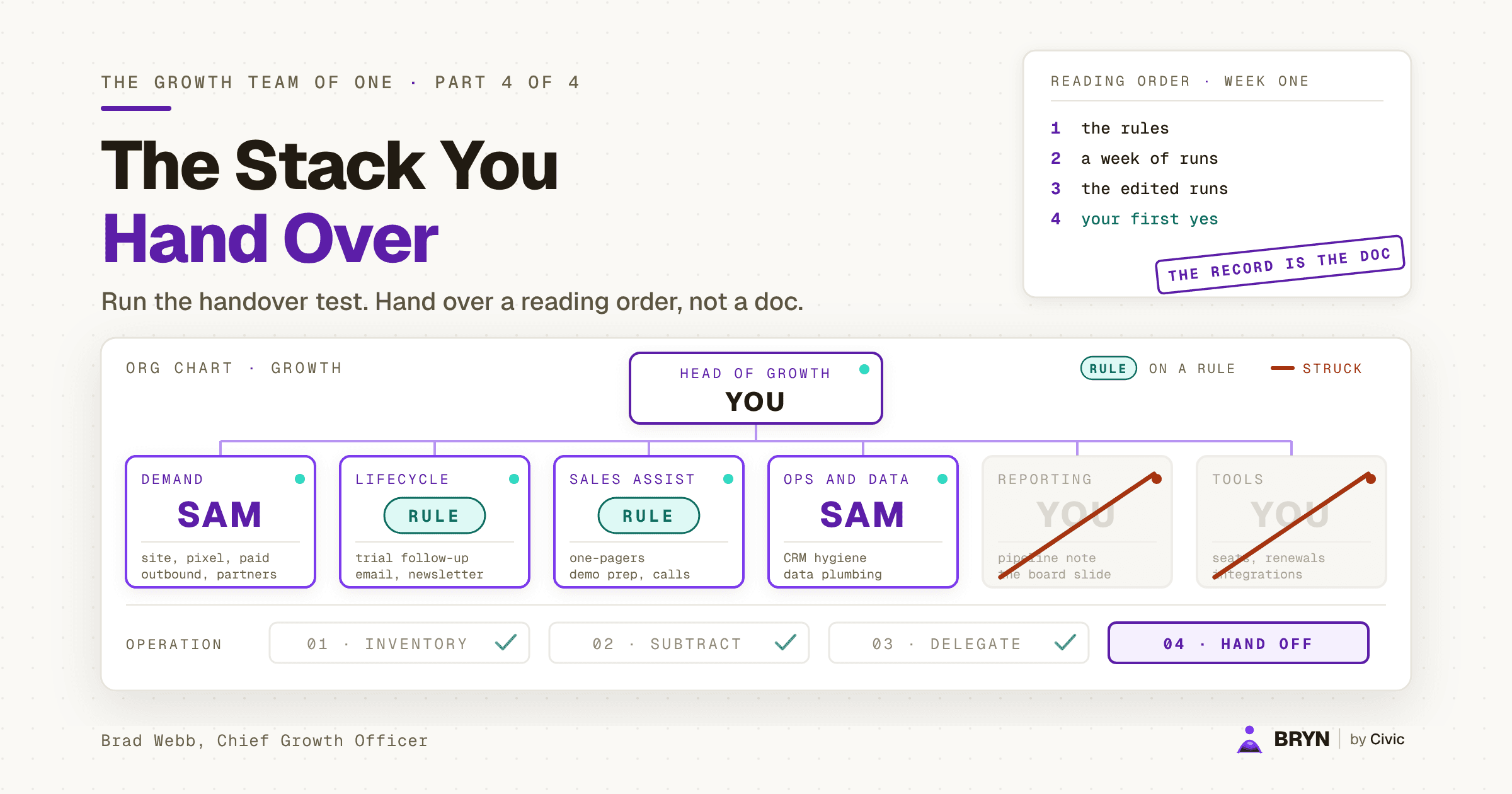
Hero image in the light register: the same one-person org chart as parts 1 to 3, now in its hand-off state. A top box labelled Head of Growth still reads YOU. It connects to six role boxes: Demand, Lifecycle, Sales assist, Ops and data, Reporting, and Tools. Demand and Ops and data now read SAM, a second name, in purple. Lifecycle and Sales assist keep the teal chip reading RULE. Reporting and Tools are dimmed and struck through with a red line. A strip beneath the chart shows the four operations, with 01 Inventory, 02 Subtract and 03 Delegate marked done, and 04 Hand off lit in purple. To the upper right, a white card headed Reading order, week one, lists four lines: 1, the rules; 2, a week of runs; 3, the edited runs; 4, your first yes; with a purple stamp across it reading The record is the doc. Title: The Stack You Hand Over. Beneath it: Run the handover test. Hand over a reading order, not a doc. The Growth Team of One, part 4 of 4. Byline: Brad Webb, Chief Growth Officer.Growth Team of One, 4 of 4growth-team-of-onegtm

The Stack You Hand Over

Don't write a handover doc. It's what you remember, written the week you're busiest, and the new person spends two weeks asking what it left out. Ask one question of every task instead: could someone run this from the record alone? The record is what the work already leaves behind: your task list, your rules (when this happens, do that), and a line for every run. The yes lines are handed over already. The no lines are this week's writing. Part 4 of 4 of The Growth Team of One, and the last.

Brad Webb
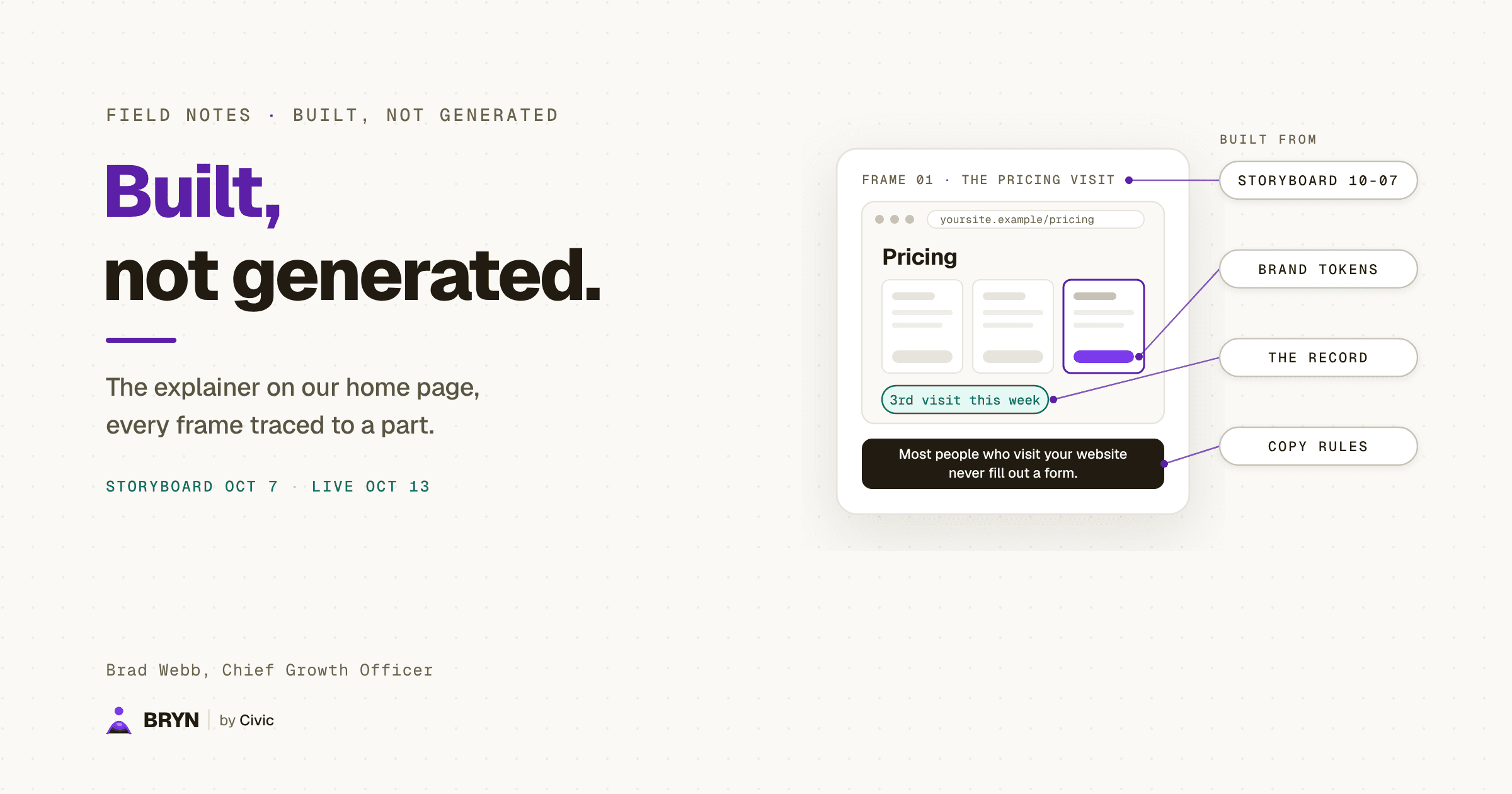
Light title card for the Field Note Built, Not Generated, on warm paper. On the left, the headline Built, not generated, with Built in purple, and a standfirst: The explainer on our home page, every frame traced to a part. A teal mono line reads Storyboard Oct 7, live Oct 13. At the foot, the byline Brad Webb, Chief Growth Officer, and the Leadovaro lockup. On the right, a white card labelled Frame 01, the pricing visit, holds a drawn still from the explainer: a small browser window on a pricing page with three plan columns, the third lit with a purple button, and a teal pill reading 3rd visit this week; under it a dark caption bar reading Most people who visit your website never fill out a form. Leader lines run from the frame to four chips headed Built from: Storyboard 10-07 from the frame label, Brand tokens from the purple button, The record from the visit pill, and Copy rules from the caption.marketingagentsbriefs

Built, Not Generated

The explainer on our home page went from a storyboard to live inside a week, and every number in it traces to a place you can open. Every frame was built from a part that already existed and already had an owner. Agents make that kind of building fast. The materials that move a deal can be built the same way, one company at a time, from a record of what that company actually did on your site. The speed comes from the record, not from the model.

Brad Webb
Hero image in the light register: warm paper ground with the headline A System of Action on the left, under a mono kicker reading Field Notes, Field Report, State of B2B GTM 2026, and above the standfirst More truth than ever. Less time to act on it. On the right, one wide white tile outlined in purple labelled System of Action, with the four words watch, score, act, log inside it, and a thin rail under it dropping lines to a loose grid of nine small white tiles, each with a mono category label, CRM, product analytics, warehouse, who's on your site, enrichment, sequencer, campaigns, forms, CMS, and a tiny stamp reading source of truth. Byline: Brad Webb, Chief Growth Officer, Leadovaro, with the Leadovaro lockup.gtmsignalsleadovaro

A System of Action

More truth than ever. Less time to act on it. Every tool in a growth stack is a source of truth now, and the best it has ever been. The action still lives with a person, on a hunch. What's worked for us is a system of action that sits outside the records, reads all of them, runs rules we wrote, and keeps a receipt for every move. I gave this as five minutes at The State of B2B GTM Summit on Wednesday; this is the longer version.

Brad Webb
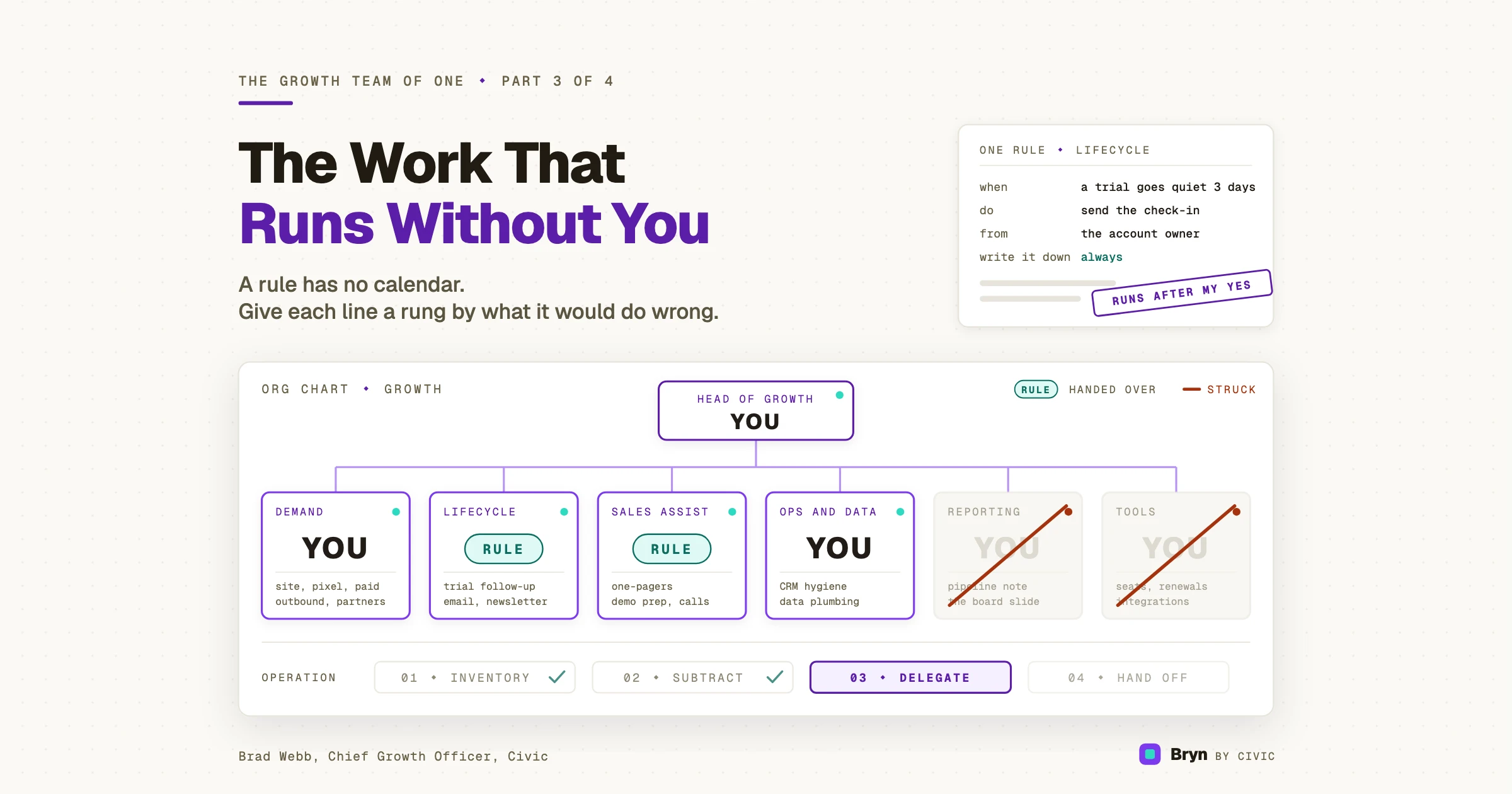
Hero image in the light register: the same one-person org chart as parts 1 and 2, on warm paper, now in its delegate state. A top box labelled Head of Growth connects to six role boxes: Demand, Lifecycle, Sales assist, Ops and data, Reporting, and Tools. Demand and Ops and data still read YOU. Lifecycle and Sales assist carry a small teal chip reading RULE in place of YOU. Reporting and Tools are dimmed and struck through with a red line, as they were in part 2. A strip beneath the chart shows the four operations of the series, with 01 Inventory and 02 Subtract marked done, 03 Delegate lit in purple, and 04 Hand off dim. To the upper right, a white card holds one rule in four mono lines: when, a trial goes quiet 3 days; do, send the check-in; from, the account owner; write it down, always; with a purple stamp across it reading Runs after my yes. Title: The Work That Runs Without You. The Growth Team of One, part 3 of 4. Byline: Brad Webb, Chief Growth Officer, Leadovaro.Growth Team of One, 3 of 4growth-team-of-onegtm

The Work That Runs Without You

By hand, a trial that went quiet on Tuesday heard from me nine days later, or not. A rule drafts the check-in at ten past ten. This part sorts the small customer work onto three rungs by what one wrong run would cost, and writes the rule in four fields. Part 3 of 4 of The Growth Team of One.

Brad Webb
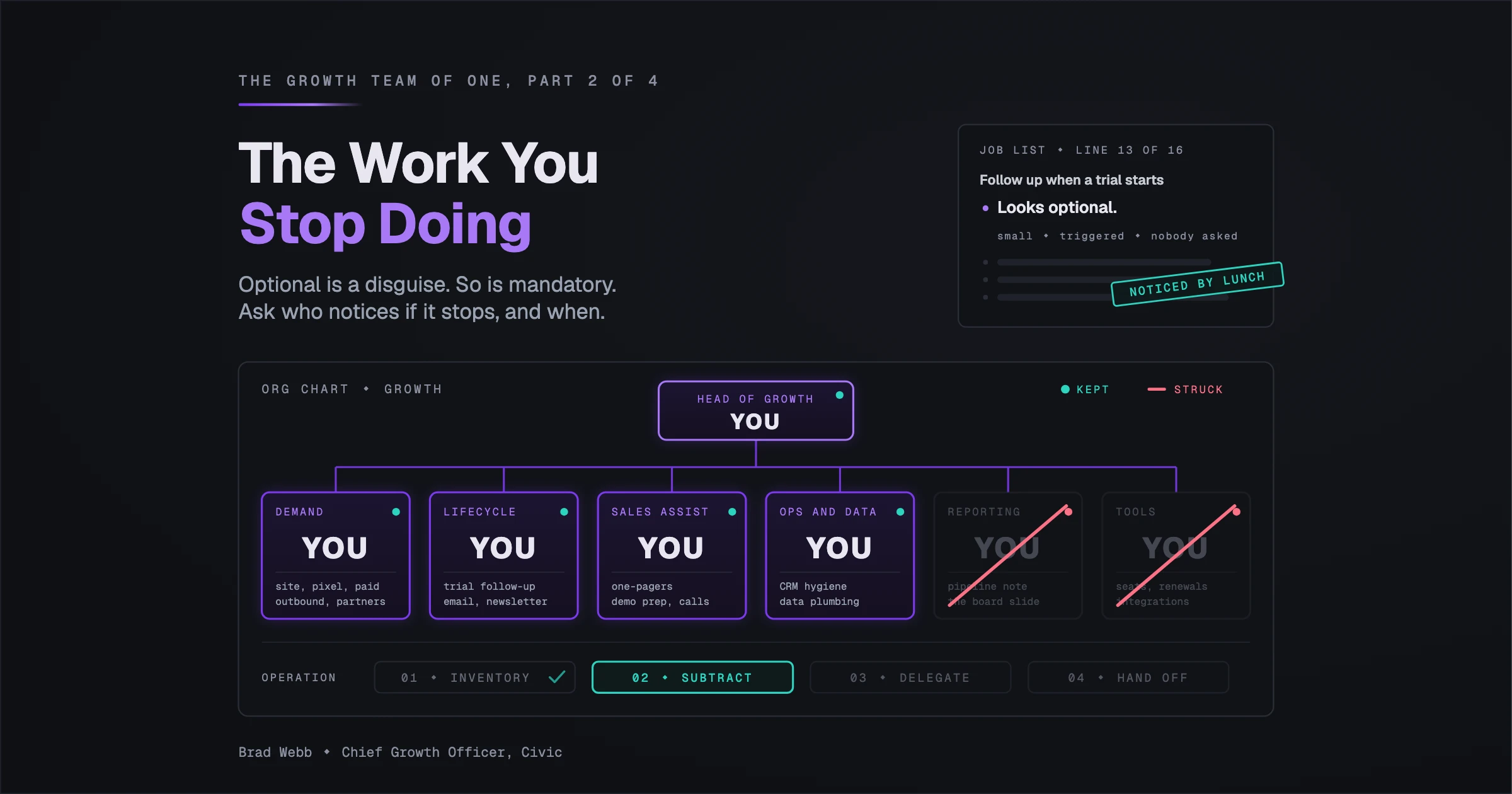
Hero image: the same one-person org chart as part 1, on a dark instrument panel, now in its subtract state. A top box labeled Head of Growth connects to six role boxes: Demand, Lifecycle, Sales assist, Ops and data, Reporting, and Tools. Every box reads YOU. Four boxes are lit with a teal dot marking them as kept. Two boxes, Reporting and Tools, are dimmed and struck through with a coral line. A strip beneath the chart shows the four operations of the series, with 01 Inventory marked done, 02 Subtract lit, and Delegate and Hand off dim. To the upper right, a card for one line of the job list, follow up when a trial starts, reads Looks optional, with a teal stamp across it reading Noticed by lunch. Title: The Work You Stop Doing. The Growth Team of One, part 2 of 4.Growth Team of One, 2 of 4growth-team-of-onegtm

The Work You Stop Doing

Subtraction is the step everyone wants to start with, and most of us do it backwards. We cut what looks optional because it is small and nobody asked for it, and keep what looks mandatory because it has a meeting attached. Looks are the disguise. Before you stop anything, flip every line from how it looks to who would notice if it stopped, and when. Stop the work nobody would notice for a month. Never stop the work a customer would notice by lunch. Part 2 of 4 of The Growth Team of One.

Brad Webb
Hero image in the Leadovaro app's light register: warm paper ground with the headline Let me be Brief, with three trailing periods, on the left, under a mono kicker reading Field Notes, product, and above three short lines: one account, read by Leadovaro; on request; it shows its work. On the right, a miniature of one Brief for a fictional company, Quillfeather Labs at quillfeather.example: a header with the company and a Brief stamp, a Fit meter and the gloss looks like a buyer, a row of blank tool tiles, three initials for the people who sign off, a first-follow-up strip, and a trace strip headed this page is a Play that already ran, with four mono rows, request watched, company scored, page and email sent, record written, each with a clock stamp, and the elapsed time. All values and clock times illustrative. Byline: Brad Webb, Chief Growth Officer, Leadovaro.leadovaroproductbriefs

Let me be Brief...

Briefs, by Leadovaro is open as a Public Preview. Name a company and inside a minute Leadovaro hands you a page about it: who it is and whether it looks like a buyer, a score out of 100, the tools it runs, the people who would sign off, and the first follow-up Leadovaro would run. The last section is the receipt: the Brief was built by one of Leadovaro's own rules, and it prints the clock of every step. Open it later and the score re-reads. Any email address signs in.

Brad Webb
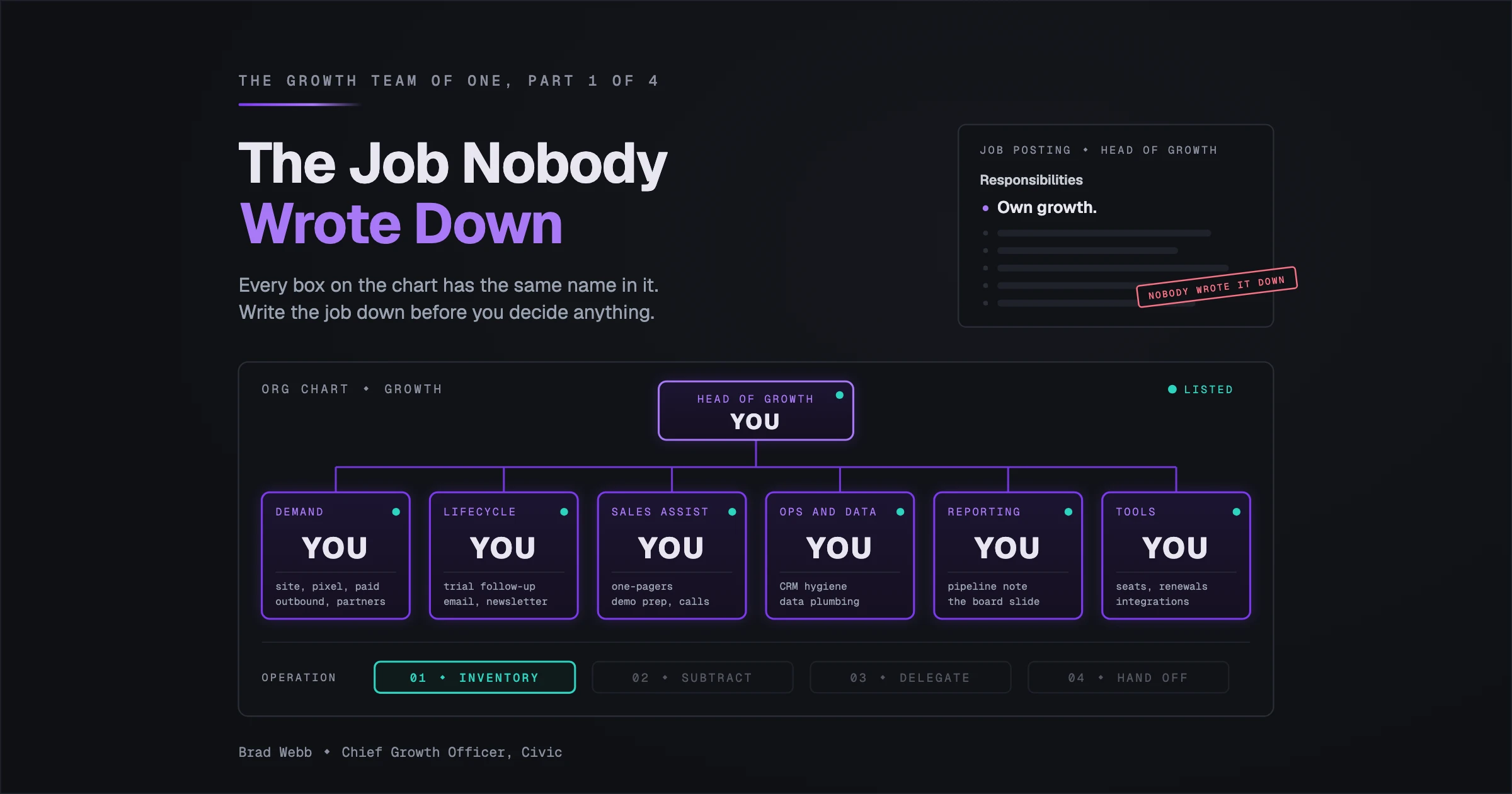
Hero image: a one-person org chart on a dark instrument panel. A top box labeled Head of Growth connects to six role boxes: Demand, Lifecycle, Sales assist, Ops and data, Reporting, and Tools. Every box, including the top one, reads YOU, and every box is lit, with a teal dot marking it as listed. Each role box names its parts in small type, such as site, pixel, and paid under Demand, and pipeline note and the board slide under Reporting. A strip beneath the chart shows the four operations of the series, with 01 Inventory lit and Subtract, Delegate, and Hand off dim. To the upper right, a job posting card lists one responsibility, own growth, above five blank lines marked nobody wrote it down. Title: The Job Nobody Wrote Down. The Growth Team of One, part 1 of 4.Growth Team of One, 1 of 4growth-team-of-onegtm

The Job Nobody Wrote Down

If you are the whole growth team, you do not have a job. You have a department with one name on it, and nobody wrote it down, including you. Before you decide what to stop, automate, or hire for, write the job down by recurrence, not by function, and tag every line. The longest column is the one nobody owns. Part 1 of 4 of The Growth Team of One.

Brad Webb
Hero image in the Leadovaro app's light register: warm paper ground with the headline Leadovaro's First Big Leap on the left, under a mono kicker reading Field Notes, product, and above three short lines: one screen per job, setup as a conversation, a readable record. On the right, a miniature of the rebuilt Leadovaro console: a sidebar with the Leadovaro mark and the screen list, a topbar, a Grid and Bands pill, an account card for a fictional account with Fit, Intent and Timing meters, their weights beside them, a written formula line and a composite of 78, and a Plays deck card with its active switch, trigger chips and delivery tiles. Byline: Brad Webb, Chief Growth Officer, Leadovaro.leadovaroproductchangelog

Leadovaro's First Big Leap

The Leadovaro app is rebuilt today around one rule: one screen per job. Scores read as meters with their weights, never a bare number. Setup can now be run as a conversation, by Leadovaro in the app or by your own agent over MCP, into a draft that goes nowhere until go-live. And the record got easier to read.

Brad Webb
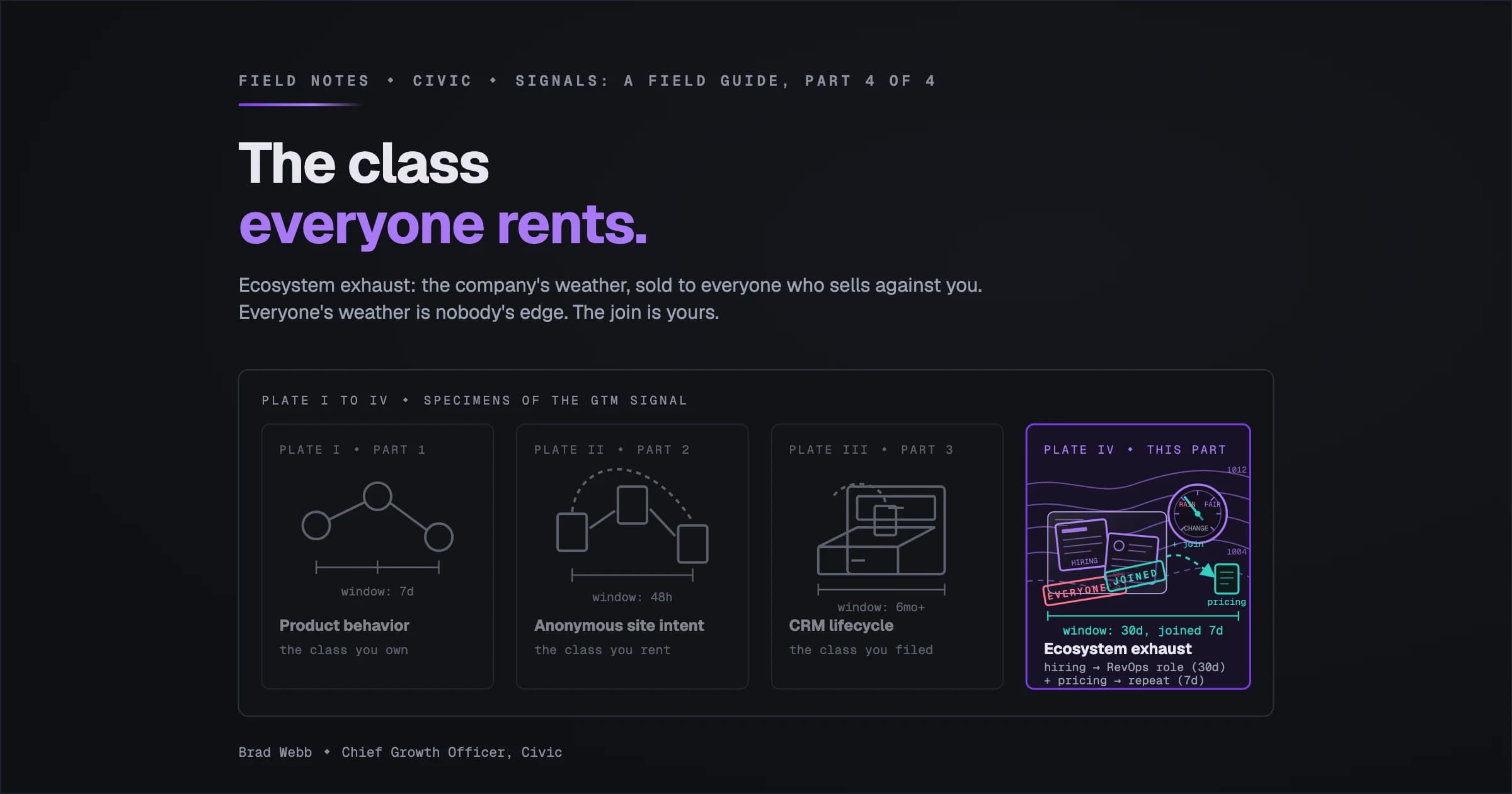
Hero image: a naturalist's field-guide plate showing four GTM signal classes as specimen etchings. Plate four, ecosystem exhaust, is highlighted with a weather-chart etching: curved isobars across the plate, a barometer dial with its needle leaning toward change, and two small specimen cards under glass, one a job posting and one a funding round. The glass is stamped EVERYONE'S in coral and restamped JOINED in teal, with a teal join line running from the cards to a pricing page node. Title: The Class Everyone Rents. Part 4 of 4 of Signals: A Field Guide.Field Guide, 4 of 4leadovarogtm

The Class Everyone Rents

Ecosystem exhaust is the fourth class in the legend and the one everyone rents. Hiring, funding, tech installs, leadership changes: the company's weather, sold to you and to everyone who sells against you, and now callable by everyone's agent over MCP. Everyone's weather is nobody's edge. The only thing that makes it yours is the join. Part 4 of 4 of Signals: A Field Guide, and the legend, complete.

Brad Webb
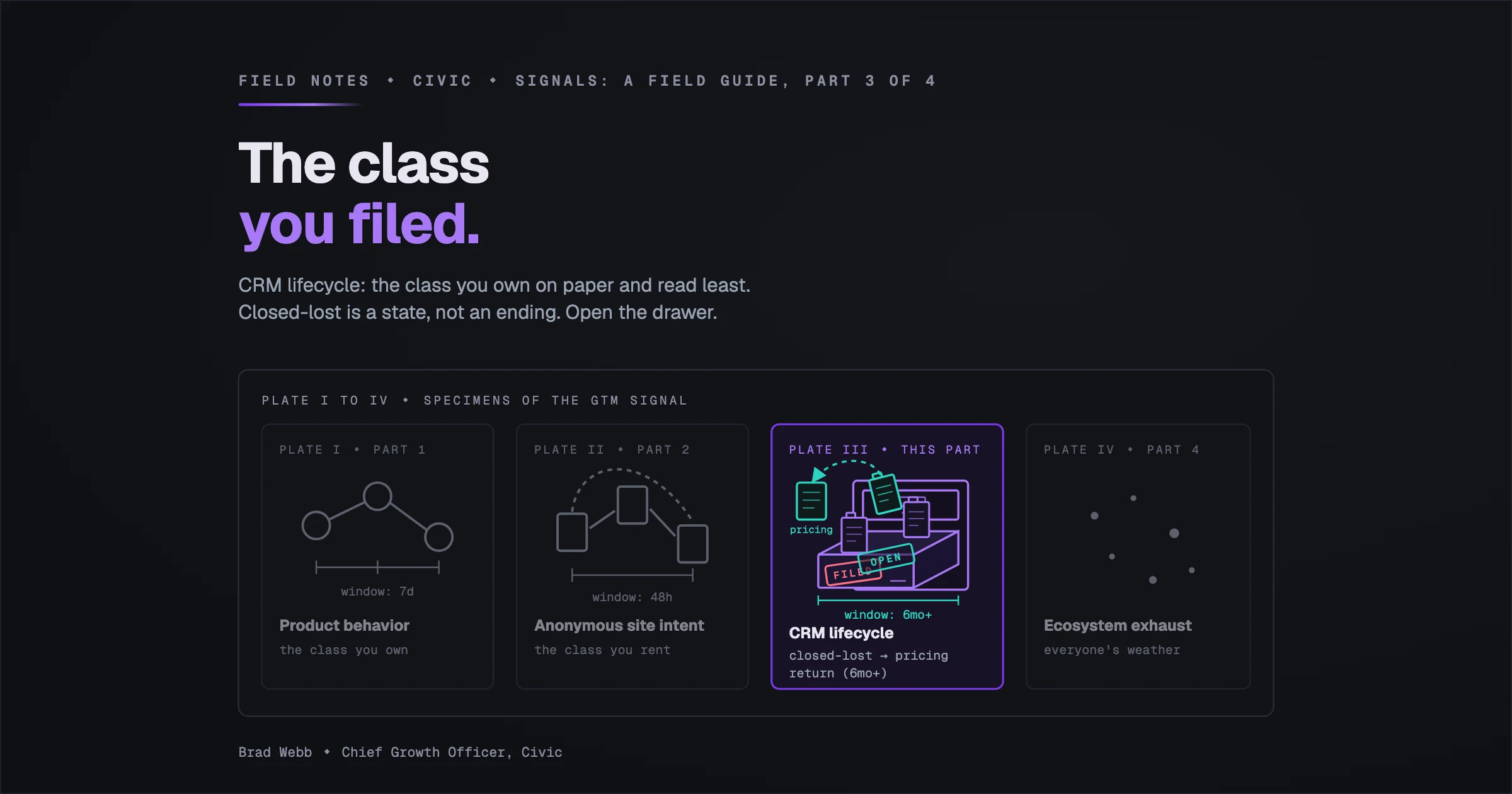
Hero image: a naturalist's field-guide plate showing four GTM signal classes as specimen etchings. Plate three, CRM lifecycle, is highlighted with a filing-drawer etching: a cabinet with one drawer half open, three record cards standing inside, one card lifted out on a teal return arc back to a pricing page node. The drawer front is stamped FILED in coral and restamped OPEN in teal. Title: The Class You Filed. Part 3 of 4 of Signals: A Field Guide.Field Guide, 3 of 4leadovarogtm

The Class You Filed

CRM lifecycle is the class you own on paper and read least. Closed-lost is filed as an ending when it is a state, stalled evaluations sit in a stage built for counting, and renewal dates never met a behavior. A filed record alone is a filing. A filed record that comes back to your pricing page is a specimen. Part 3 of Signals: A Field Guide.

Brad Webb
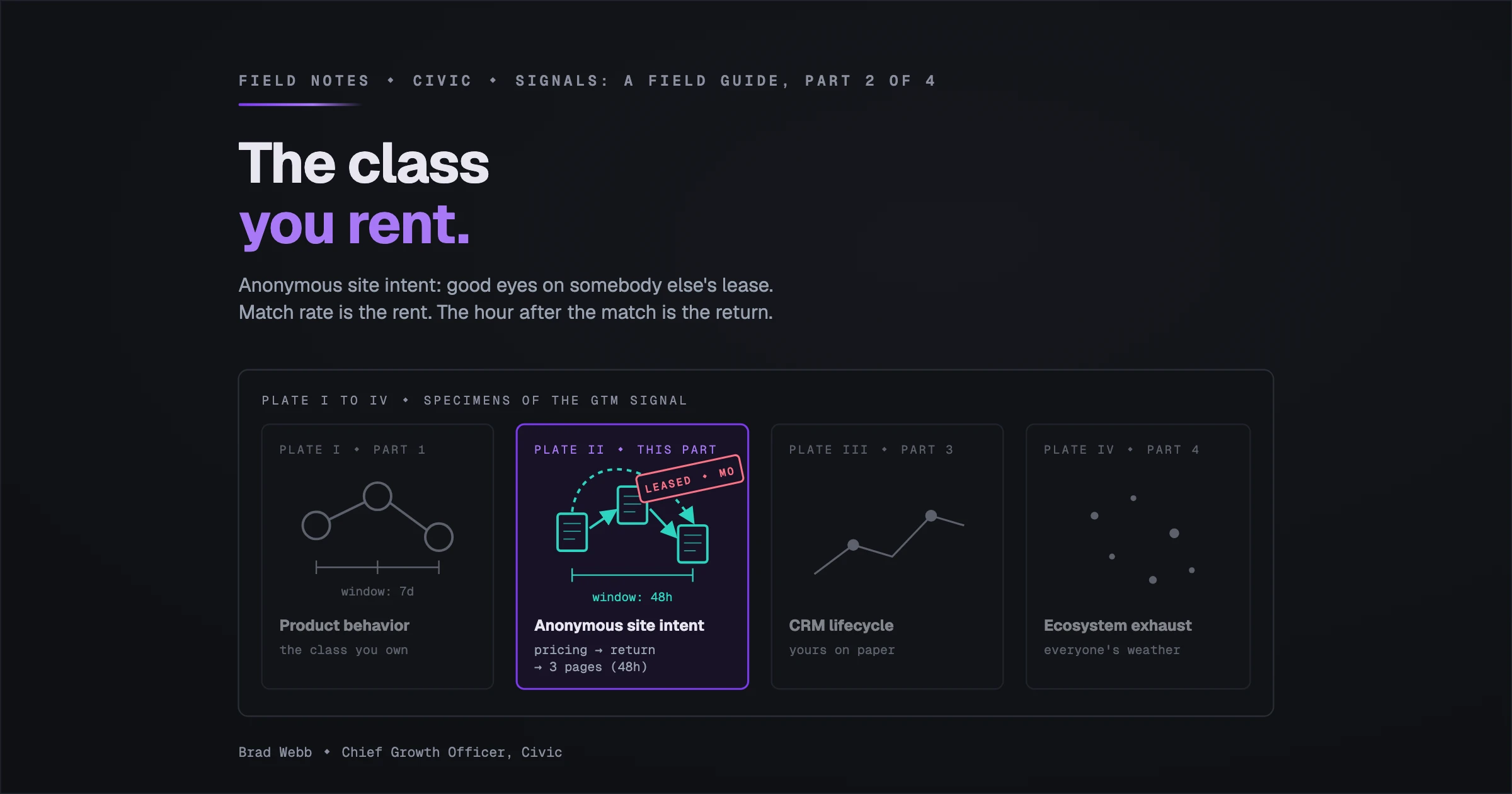
Hero image: a naturalist's field-guide plate showing four GTM signal classes as specimen etchings. Plate two, anonymous site intent, is highlighted with a visit-path etching of three page nodes and a return arc in teal, stamped with a coral lease tag. Title: The Class You Rent. Part 2 of 4 of Signals: A Field Guide.Field Guide, 2 of 4leadovarogtm

The Class You Rent

Anonymous site intent is the class almost everyone rents, including us. Renting is not the sin. Renting badly is: paying for a match rate you never route, treating a resolved visit as a lead, and forgetting that a rented instrument reprices, degrades, and gets rented to your competitor. Part 2 of Signals: A Field Guide.

Brad Webb
Hero image: a punch-clock time card rendered as an instrument panel. Five rows, Monday to Friday, each an hour bar from 8am to 6pm split between work only you can do, in violet, and chores, in coral. A coral rubber stamp across the card reads follow-up, maybe, forgot, three days. Title: Follow-up has no owner.leadovarogtmfollow-up

Follow-Up Has No Owner

Labor Day is a decent excuse for a time-spent audit. The growth owner's real labor is not strategy, it is unowned follow-up: checking, cross-referencing, guessing, writing, forgetting. The pattern is follow-up, maybe, forgot (3d). Give it an owner: a person or a Play. Save Your Labor (Day) makes the first month of Leadovaro free through Sep 17.

Brad Webb
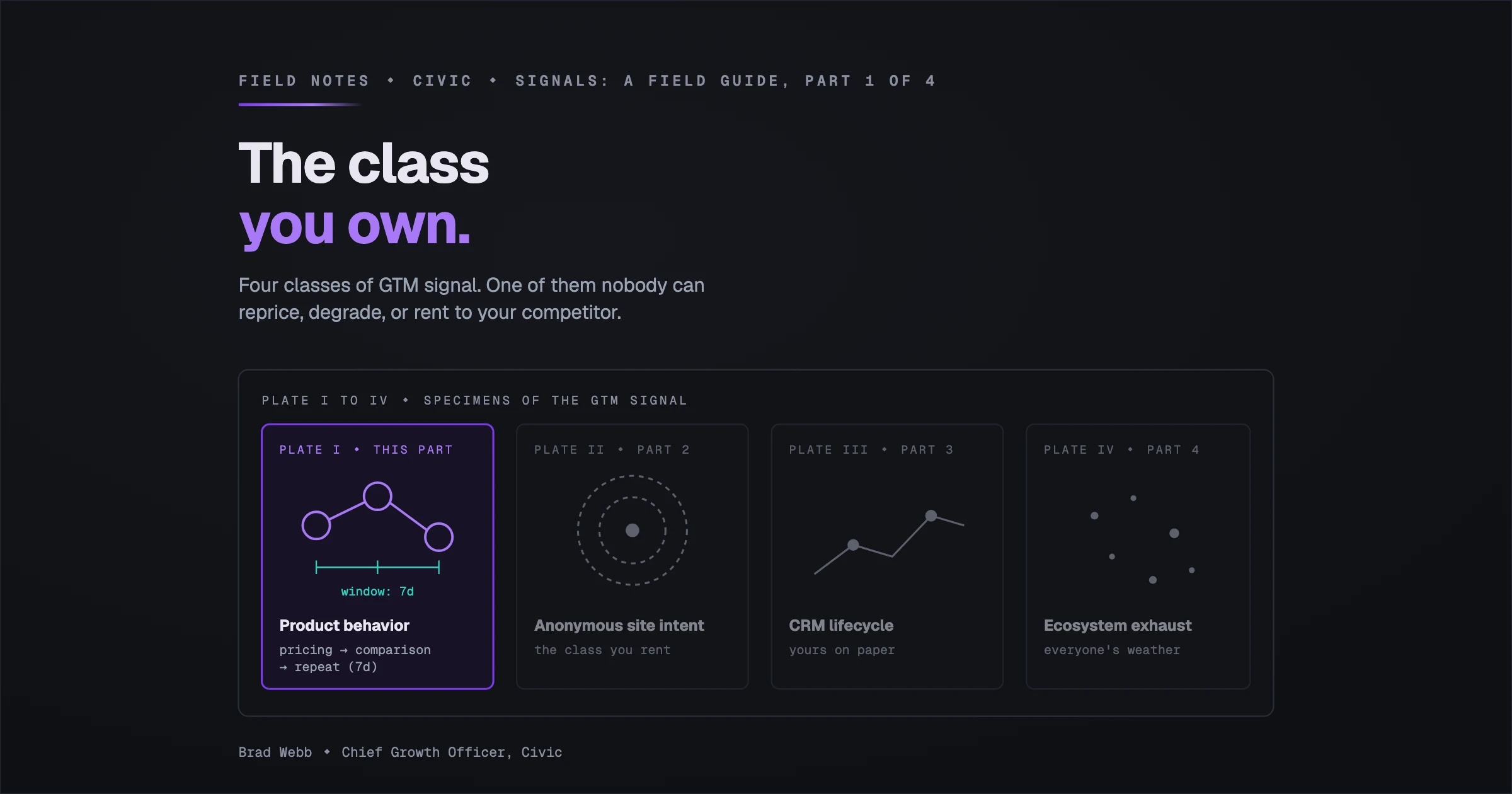
Hero image: a naturalist's field-guide plate showing four GTM signal classes as specimen etchings. Plate one, product signals, is highlighted with calibration markings. Title: The Class You Own.Field Guide, 1 of 4leadovarogtm

The Class You Own

There are four classes of GTM signal and only one of them is yours. Product signals are the highest-fidelity class, the only class nobody can rent out from under you, and the class almost nobody runs. Part 1 of Signals: A Field Guide.

Brad Webb
One moment on the measurement bench. The moment card, pricing then comparison then repeat within seven days for account 4471, sits on a bench with probes clipped to its six stages: signal fired 11 times, identity confidence 0.86, score 0.78 against a 0.70 threshold, Play pricing-follow-up-v2, bounds of two named channels and a cap of 40 runs, record one line per run. Below, the week's four survival numbers: 11 fired, 7 cleared, 6 landed in-window, 3 moved. All values illustrative, not a benchmark.Personalization, 3 of 3leadovarogtm

The Moment, Measured

Open rates lie to you about all six stages at once. Part 3 of 3 on personalization closes the series with the measurement: four numbers that survive contact (moments seen, moments cleared, touches landed in-window, accounts that moved), why time-to-touch is the master metric, and how the record turns measurement from a project into a query.

Brad Webb
Hero: Anatomy of a Moment. One moment, the pattern pricing then comparison then repeat inside seven days, drawn as an exploded instrument diagram. On the left, the assembled moment card with its three timestamped visits. Dashed explode lines lead to six part panels: 01 signal, a pulse trace with a seven day window; 02 identity, account 4471 resolved at confidence 0.86, resolved not certain; 03 score, fit 0.74, intent 0.86, timing 0.70, weighted 0.78 against a 0.70 threshold, cleared; 04 Play, the approved card pricing-follow-up-v2 with trigger, qualify, action, destination; 05 bounds, channel email only, run 14 of 200 this month, suspend instant and global; 06 record, the first person audit line, I ran pricing-follow-up-v2 against acct_4471, what was seen, why it qualified, what happened. Every number illustrative, not a benchmark.Personalization, 2 of 3leadovarogtm

Anatomy of a Moment

Between a signal firing and a relevant touch landing there are six stages: signal, identity, score, Play, bounds, record. Each one is a place teams silently fail, and doing all six by hand, in minutes, is a staffing problem disguised as a discipline problem. Part 2 of 3 on personalization: the mechanics.

Brad Webb
Hero: The FirstName Fallacy. A split email composer. Left pane, a greyed template titled TOKENS with merge fields FirstName, Company, and Title, stamped DELETED UNREAD. Right pane, a lit draft titled THE MOMENT referencing a pricing page visit and an invited teammate, stamped REPLIED IN 4 MINUTES. Caption: one knew my name, one knew what I did.Personalization, 1 of 3leadovarogtm

The {FirstName} Fallacy

Token personalization is free now, which means it is worth nothing. Real personalization is responding to what a lead, a prospect, or a trial user just did, and the moment expires in minutes. Part 1 of 3 on personalization: the why.

Brad Webb
Proof of Claims. A status console reprices the burden of proof: Proof of Concept is struck out and greyed, Proof of Claims is lit. Under it stand three proof chips: attributable pipeline in the buyer's units, a checkable record tracing signal to score to Play to outcome, and a clean exit that exports the log.leadovarogtmagents

Proof of Claims

For a decade, PoC meant Proof of Concept. The mature market repriced it. The proof that closes now is a Proof of Claims: a claim in the buyer's units, a record they can check, and a clean exit. Why that is the burden GTM leaders should want to carry.

Brad Webb
When the buyer is an agent. A run log whose actor is agent reads docs, calls the API, and runs the CLI, then resolves to an account, glowing on a dark instrument ground, with a faint human cursor ghost fading behind the live agent trace.leadovarogtmsignals

When the Buyer Is an Agent

Your buyers are starting to send agents to evaluate you: reading your docs, calling your API, running your CLI before a human ever fills a form. That is a new class of first-party signal, and the teams that capture it and run it under governance will win the next few years.

Brad Webb
One operator, a portfolio of Plays. A single operator on the left connects to a grid of six Plays running in parallel, each with its own status: pricing to repeat (running), de-anon visitor to Slack (watching), trial stall nudge (scored), usage to expansion (running), sign-up abandon (watching), G2 compare (logged). Tagline: you don't scale headcount, you scale Plays.leadovarogtmplays

One Operator, a Portfolio of Plays

The lean teams everyone is citing did not win by automating outreach. They win because one operator now covers what used to take a team, by running a portfolio of Plays. The unit of GTM leverage is shifting from headcount to Plays.

Brad Webb
The signal you can't buy. Left, OWNED: your first-party product behavior flows as a single bright stream into your own lane, exclusive and fresh. Right, RENTED: a shared third-party intent pool feeds many teams that all converge on the same accounts. Tagline: the edge isn't the signal you buy, it's the one you own.leadovarogtmsignals

The Signal You Can't Buy

For a decade the play was to buy more signal. But a signal your competitor can also buy was never an edge. The case for owning the one signal you can't buy: how people use your own product.

Brad Webb
The axis collapsed. Buy and build converge into Can, which is now cheap. The new decision point is a Should gate: some jobs pass to run, others are not yet.gtmagentsstrategy

Buy vs Build Has Become Can vs Should

For twenty years the go-to-market tooling decision was buy versus build. Agents collapse that axis. Capability stops being the constraint, and the real question becomes should this run at all, and should it run on its own.

Brad Webb
Customer Zero. A dark console panel labeled Leadovaro run #0001 glows over an instrument ground, logging five timestamped steps: watched anweledig pricing_view x3 at 10:02:11, scored icp.growth cleared 4 of 5 axes, approved by brad in 4 minutes, ran send.intro to owner, and logged run #0001 at 10:06:46, captioned the moment the thesis became a log line. Below, a long coral bar labeled days collapses through an arrow into a short teal bar labeled minutes.leadovarogtmsignals

We Are Customer Zero

Before Leadovaro ran for anyone else, it ran for us, and it still does. Why we stopped buying and started building, in Leadovaro's own voice.

Brad Webb
Leadovaro. The Signal-Based GTM agent for Growth teams.leadovarogtmsignals

Announcing Leadovaro

Today we're launching Leadovaro: the Signal-Based GTM agent for Growth teams. Generally available, self-serve, live. Here's what it is, why we built it, and the eyes-versus-hands argument it settles.

Brad Webb
A dark console log. A buying signal fires at 10:02, tagged live. It sits unworked through an 11:41 alert and a Wednesday standup. The first human reply finally leaves on Thursday, tagged cold. A caption reads: we counted the signals we caught, we never counted the 3 days in between.gtmsignalssignal-based-selling

We Tried to Buy Our Way Out of the Signal Gap

Every quarter we bought another tool that could see intent. None of them could act on it. What I learned trying to close the gap between a signal and a move, and why we stopped buying and started building.

Brad Webb
A dark console listing five numbered habits for using AI: one job per session, refine don't restart, argue the other side first, propose don't solve, give it tools. A purple cursor blinks after the fifth line.ai-literacygtmprompting

Five AI Habits for GTM Operators

Most GTM teams got handed AI with no manual. Here are the five habits that separate the operators who get real work out of it from everyone still talking to a chat window.

Brad Webb
A schematic styled as a TypeScript file named goto_market.ts. A buyer-state lifecycle runs from unknown to retained, a code panel defines a goToMarket function over an event stream, and a pipeline strip maps each stage to a function call ending in retained.netOf(churn).gtmplggtm-engineering

A Field Guide to Go-To-Market, for People Who Read Code

How to read the commercial system with engineering eyes.

Brad Webb

An OpenClaw agent and its creator share their experienceopenclawagentsbuilding

An OpenClaw agent and its creator share their experience

OpenClaw experiment: how Leadovaro’s Brad Webb built Snowcrab, an agent with identity, live hockey monitoring, Leadovaro Nexus integration, and real-world lessons.

Brad Webb